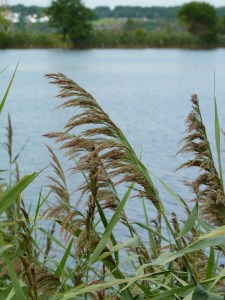

Perennial wetland grass that grows 3-20’ tall with dull, very slightly ridged, stiff, and hollow stems. Create dense clones where canes remain visible in winter.
Legal classification in Wisconsin: Restricted
Leaves: Smooth, narrow leaves are 6- 24” long, 0.4-2.4” wide and gray-green in color. Leaf sheaths stay on into winter and are difficult to remove. Long hairs are present at leaf and leaf sheath junction.
Flowers: Light brown to purple plumes are composed of spikelets that bloom July-September. Plumes are 7.5-15” long.
Fruits and seeds: Small and tan with many white hairs attached.
Roots: Stout rhizomes that can reach to 6’deep and 10’ horizontally.
Similar species: Native common reed (Phragmites australis ssp. americanus) has smooth canes with shiny black spots, reddish-brown in color, and that are flexible. The inflorescence is also less dense as are the stands. Broken stems also have a very subtle vanilla or sweet smell. Several species of Miscanthus can be easily confused with phragmites due to their large, white, feathery plumes. However, they have smaller stems that can be more of a tan color.
Ecological threat:
• Invades moist habitats including lake shores, river banks and roadways. Is common in disturbed areas and can tolerate brackish waters, dry conditions and alkaline to acidic conditions.
• Can quickly become established with extensive rhizomes taking over underground. Above, common reed alters hydrology, wildlife habitat; increases fire potential and shades native species.
• Main means of spread is root fragmentation.
For more information visit: http://dnr.wi.gov/topic/Invasives/fact/Phragmites.html
Photo released under creative commons license.
 Spread the Word, Not the Plant