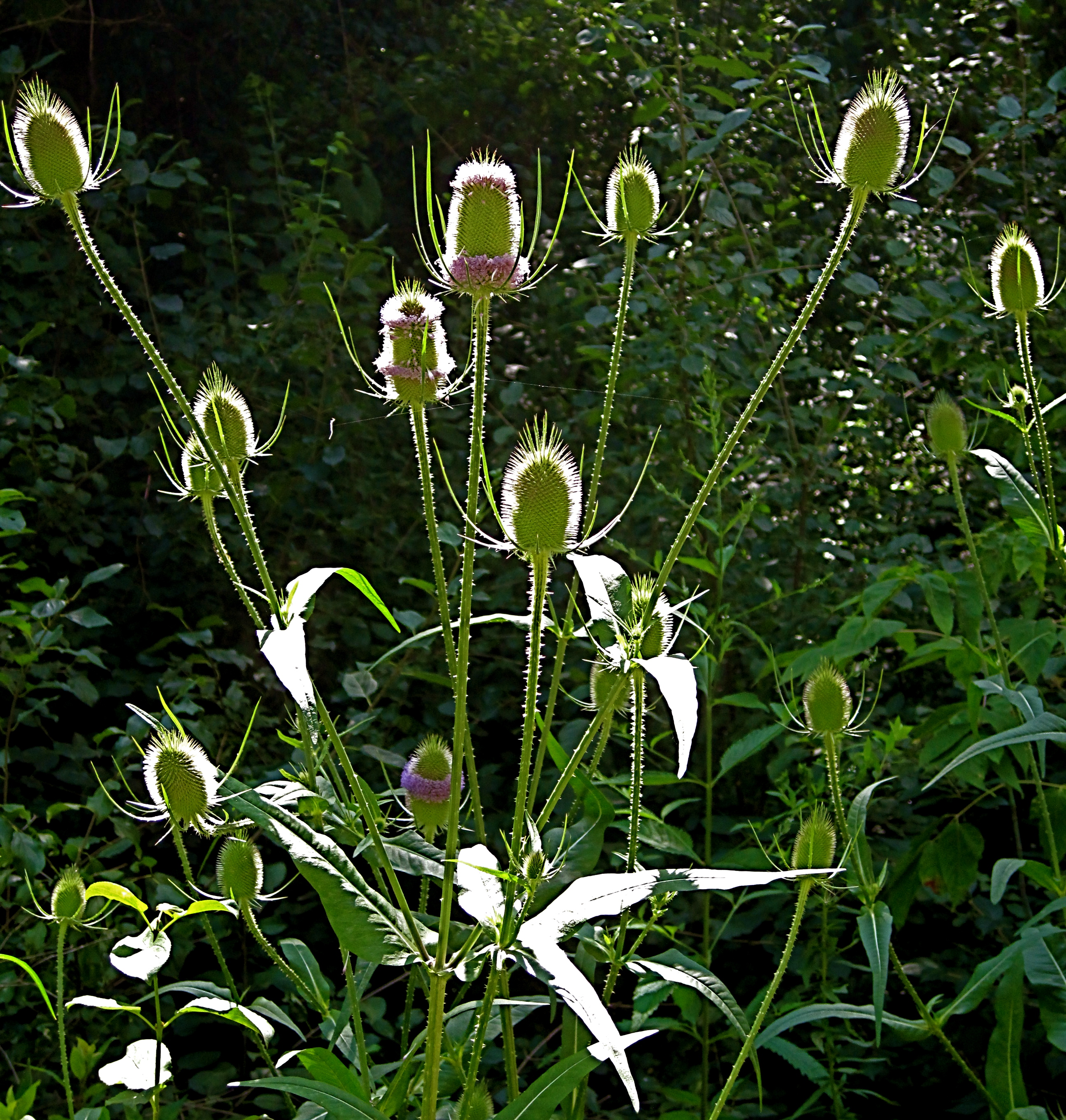
Teasels are herbaceous plants that grow as a basal rosette for at least one year. Plants form a spiny, angled flowering stalk, 2-6′ tall, typically in second or third year, then dies (monocarpic perennial).
Legal classification in Wisconsin: Restricted
Leaves: Stem leaves are opposite, large (up to 1.5′ long), oblong, and covered in spines, especially along the midrib. Leaves of flowering plants join into cup around stem. Rosette leaves are oval in young rosettes to oblong and hairy in older rosettes. The stem leaves are not lobed.
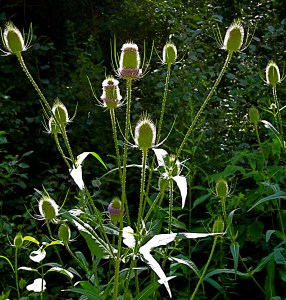
Flowers: Summer. Small flowers clustered in dense, oval heads 2-5″ long. Stiff, spiny, leaf-like bracts curve up from base of flower head. Purple flowers and bracts longer than the flower heads. Sometimes the flowers can be white, more common with the cut-leaved teasel.
Fruits and seeds: Fruits are light brown, ridged, and hairy. About 1/5″ long and each fruit contains a single seed. Fruit are borne on a compact inflorescence at end of flowering stalk.
Roots: Deep taproot, up to 2′ long and 1″ in diameter.
Similar species: None known.
Ecological threat:
• Invades open areas, including prairies, savannas, sedge meadows, roadsides and disturbed areas.
• Teasel is still used in horticultural plantings and dried flower arrangements.
For more information visit: http://dnr.wi.gov/topic/Invasives/fact/CommonTeasel.html
Photo released under creative commons license.
 Spread the Word, Not the Plant